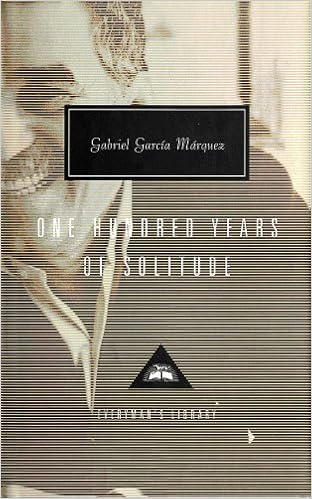
For my fiction novel, I chose to read Gabriel Garcia Márquez's 100 Years of Solitude (translated from the original Spanish by Gregory Rabassa).
From the Publisher:
The brilliant, bestselling, landmark novel that tells the story of the Buendia family, and chronicles the irreconcilable conflict between the desire for solitude and the need for love—in rich, imaginative prose that has come to define an entire genre known as “magical realism.”
About the Author:
Gabriel García Márquez is a journalist, screenwriter, and fiction author. Aside from 100 Years of Solitude, he's also written notable books such as Love in the Time of Cholera and The Autumn of the Patriarch. He won the Nobel Prize in Literature in 1982.
Why this Book?
I struggled a great deal with picking a fiction book to read--unsurprising considering I'm probably one of the most indecisive people on the planet. At first I was dead-set on John Irving's A Prayer for Owen Meany since it'd been on my "To Read" list since forever, but with 640 pages and none of the awards required to make the cut, I realized it would probably be better to save it for the summer.
Thus, my local-library-raiding-escapade began. Unfortunately for me, I'm really particular about having to like a book in order to read it. Unless forced to read it for school (I'm looking at you The White Giraffe), I don't think I've ever completed a book I didn't like, and I wasn't about to start now. Usually I can tell pretty quickly whether I'll enjoy a book, so I figured I'd just check out and read the first chapter of the 5-6 books I thought were worth considering and go from there. Of course, even after all that, I could only narrow it down to 100 Years of Solitude and All the Light We Cannot See. Both have them have really pretty, lyrical prose rife with metaphors and similes (the kind of writing I absolutely adore), so I had no idea what to pick. Staring at the sign-up sheet for book choices the next day, I realized that I had walked up without knowing what book I was writing down, so I proceeded to hover there awkwardly, trying not to hold up the line. Finally I just went, "ah, fork it" and chose 100 Years of Solitude. (I'm not going to lie, as great as the prose in All the Light We Cannot See is to read, the plot seemed to be heading in a direction that could've gotten very cliche very fast.)
But the real question here is why choose a book where most of the characters have the exact same (or similar variation on the same) name. Honestly, I'm not sure. Unsurprisingly, most readers say it's incredibly confusing to read at points, especially considering how many characters there are. I mean there's literally 22 characters in the family tree (provided in the front of my copy of the book) with the name Aureliano. Still, there's something really enrapturing about the book and its writing despite the peculiar fantastical elements (like the dirt-eating Rebeca). Plus, it's one of like a grand total of ten books my mom has gotten through and enjoyed since college so I figure there must be something really special about it. The magical realism had be intrigued too. I don't really like reading fantasy anymore despite loving it as a child, but over the summer I read The Particular Sadness of Lemon Cake. Not only was the prose beautiful, but the fantastical element (the main character's ability to taste the emotions of who cooked the food she eats) was really interesting. It's a bit stunted thematically, though I think it's worth reading if only just for the prose and the character development, but I digress. That book got me interested in the magical realism genre, so it's cool to read the novel that supposedly started that entire genre.
Thus, my local-library-raiding-escapade began. Unfortunately for me, I'm really particular about having to like a book in order to read it. Unless forced to read it for school (I'm looking at you The White Giraffe), I don't think I've ever completed a book I didn't like, and I wasn't about to start now. Usually I can tell pretty quickly whether I'll enjoy a book, so I figured I'd just check out and read the first chapter of the 5-6 books I thought were worth considering and go from there. Of course, even after all that, I could only narrow it down to 100 Years of Solitude and All the Light We Cannot See. Both have them have really pretty, lyrical prose rife with metaphors and similes (the kind of writing I absolutely adore), so I had no idea what to pick. Staring at the sign-up sheet for book choices the next day, I realized that I had walked up without knowing what book I was writing down, so I proceeded to hover there awkwardly, trying not to hold up the line. Finally I just went, "ah, fork it" and chose 100 Years of Solitude. (I'm not going to lie, as great as the prose in All the Light We Cannot See is to read, the plot seemed to be heading in a direction that could've gotten very cliche very fast.)
But the real question here is why choose a book where most of the characters have the exact same (or similar variation on the same) name. Honestly, I'm not sure. Unsurprisingly, most readers say it's incredibly confusing to read at points, especially considering how many characters there are. I mean there's literally 22 characters in the family tree (provided in the front of my copy of the book) with the name Aureliano. Still, there's something really enrapturing about the book and its writing despite the peculiar fantastical elements (like the dirt-eating Rebeca). Plus, it's one of like a grand total of ten books my mom has gotten through and enjoyed since college so I figure there must be something really special about it. The magical realism had be intrigued too. I don't really like reading fantasy anymore despite loving it as a child, but over the summer I read The Particular Sadness of Lemon Cake. Not only was the prose beautiful, but the fantastical element (the main character's ability to taste the emotions of who cooked the food she eats) was really interesting. It's a bit stunted thematically, though I think it's worth reading if only just for the prose and the character development, but I digress. That book got me interested in the magical realism genre, so it's cool to read the novel that supposedly started that entire genre.
No comments:
Post a Comment